The stabilizer formalism is a method for creating error correcting codes using the Pauli-group. In addition to allowing certain errors to be detected and corrected, logical gates can also be performed in this framework.
From these operators all elements of the one qubit Pauli-group can be generated. The Pauli-group is the set of Pauli-operators plus identity with all possible phases of {±1,±i}.
The n-qubit Pauli-group , Pn, is then the n-fold tensor product of elements in the one qubit Pauli-group. All elements in Pn either commute or anit-commute,
All elements of the Pauli-group have eigenvalues {+1,−1} or {+i,−i}. Here, we mostly consider just the elements with eigenvalues {+1,−1} (the Hermitian elements of the Pauli-group).
such that −I∈/S. The stabilizers are therefore an Abelian subgroup of the n-qubit Pauli-group, Pn, such that all logical states (states in the code space) are (+1) eigenstates of each stabilizer, that does not contain the negative identity operator.
The justification of these conditions are as follows:
Pi∣ψ⟩L=∣ψ⟩L∀∣ψ⟩L:
This avoids any logical information encoded in the code space being destroyed when a stablizer is measured on ∣ψ⟩L.
Further Details
A state, ∣ω⟩ is said to be stabilized by an operator U if U∣ω⟩=∣ω⟩, meaning ∣ω⟩ is a (+1) eigenstate of U.
From the above definition of S, it can be seen that ∀Pi∈S all logical states ∣ψ⟩L are stabilized by Pi. Therefore, if one were to measure or apply Pi on any logical state ∣ψ⟩L they would return the state ∣ψ⟩L unchanged. This avoids any logical information encoded in the code space being destroyed when a stablizer is measured on ∣ψ⟩L. (Does it also prevent loss of logical information in general? I am currently not sure).
One can reverse this definition, and defined the code space to be the subspace of the total Hilbert space that is stabilized by all elements of S. Phrased alternatively, the code space is defined as the intersection of all (+1) eigenspaces of the elements of S.
[Pi,Pj]=0:
If this condition is not met, only the trivial space can be stabilized.
Proof
Let Pi,Pj∈Pn such that [Pi,Pj]=0. Moreover, assume they both stabilize ∣ψ⟩L such that
This is only true if ∣ψ⟩L=0, meaning that non-Abelian subgroups of Pn can only stabilize a trivial subspace.
(Note, the equation ∣ψ⟩=−∣ψ⟩ is about the physical equivalence of vectors in a Hilbert space, with this equation only being satasfied for the zero vector. It is not about whether two states are physically distinguishable under global phases.)
−I∈/S:
If this condition is not met, only the trivial space can be stabilized.
where Π+1i is the projector onto the +1 eigenspace of Pi and Π−1i the projector onto the -1 eigenspace of Pi. One can then defined the code space via the projector
which is the projector onto the intersection of all the positive eigenspaces of the stabilizers.
The intersection of all the different combinations of the positive and negative eigenspaces of the stabilizers are all pairwise orthogonal, and they define each of the orthogonal subspaces of the QEC code.
An error that maps the code space to one of these orthogonal subspaces can therefore be detected by measuring the observable who’s eigenspaces are exactly these orthogonal subspaces.
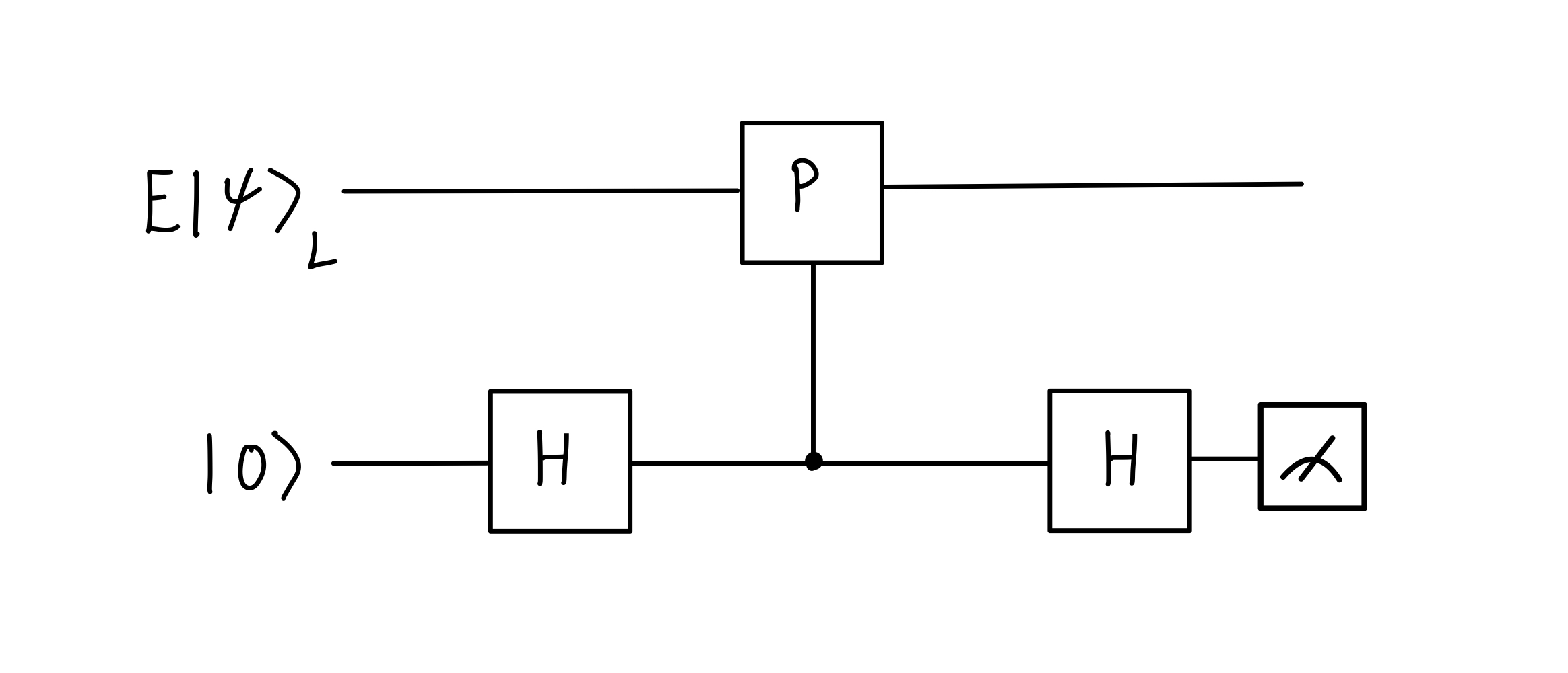
All elements of Pn are unitary. If P∈Pn is also Hermitian, then any stabilizer P can be measured on the logic state indirectly, with the measurement outcome stored in an ancilla 💭.
A schematic of the circuit used to measure the stabilizer P on the logical state ∣ψ⟩L.
Assume that P∈Pn is a stabilizer of the logical state ∣ψ⟩L such that P∣ψ⟩L=∣ψ⟩L. Let E be some correctable error that has occurred on the logical state, such that P(E∣ψ⟩L)=E∣ψ⟩L or P(E∣ψ⟩L)=−E∣ψ⟩L, depending on whether E∣ψ⟩L is in the positive or negative eigenspace of P.
The input state into the circuit is E∣ψ⟩L∣0⟩A, where A labels the ancillary space and the L subscript now doubles as a label for the space of the logical state.
such that a Z measurement performed on the ancilla now gives the outcome -1 (syndrome bit 1) with certainty.
By performing the above circuit and measuring the ancilla one can therefore determine if the logical state is in the +1 or -1 eigenspace of the stabilizer P.
When discussing the 2-bit repetition code it was noted that the measurement of the stabilizer was akin to performing a parity check on the qubits. Specifically, a logical qubit was encoded into space Span{∣00⟩,∣11⟩} such that
It was then seen that it was possible to perform error detection on the set of errors {I,X1,X2} by measuring the stabilizer Z1⊗Z2. If I occurs, the state stays in the code space and measuring the stabilizer gives the output +1 (syndrome bit 0). If either an X1 or X2 occurs, the state is mapped into the space Span{∣01⟩,∣10⟩}, and a measurement of the stabilizer gives the output -1 (syndrome bit 1).
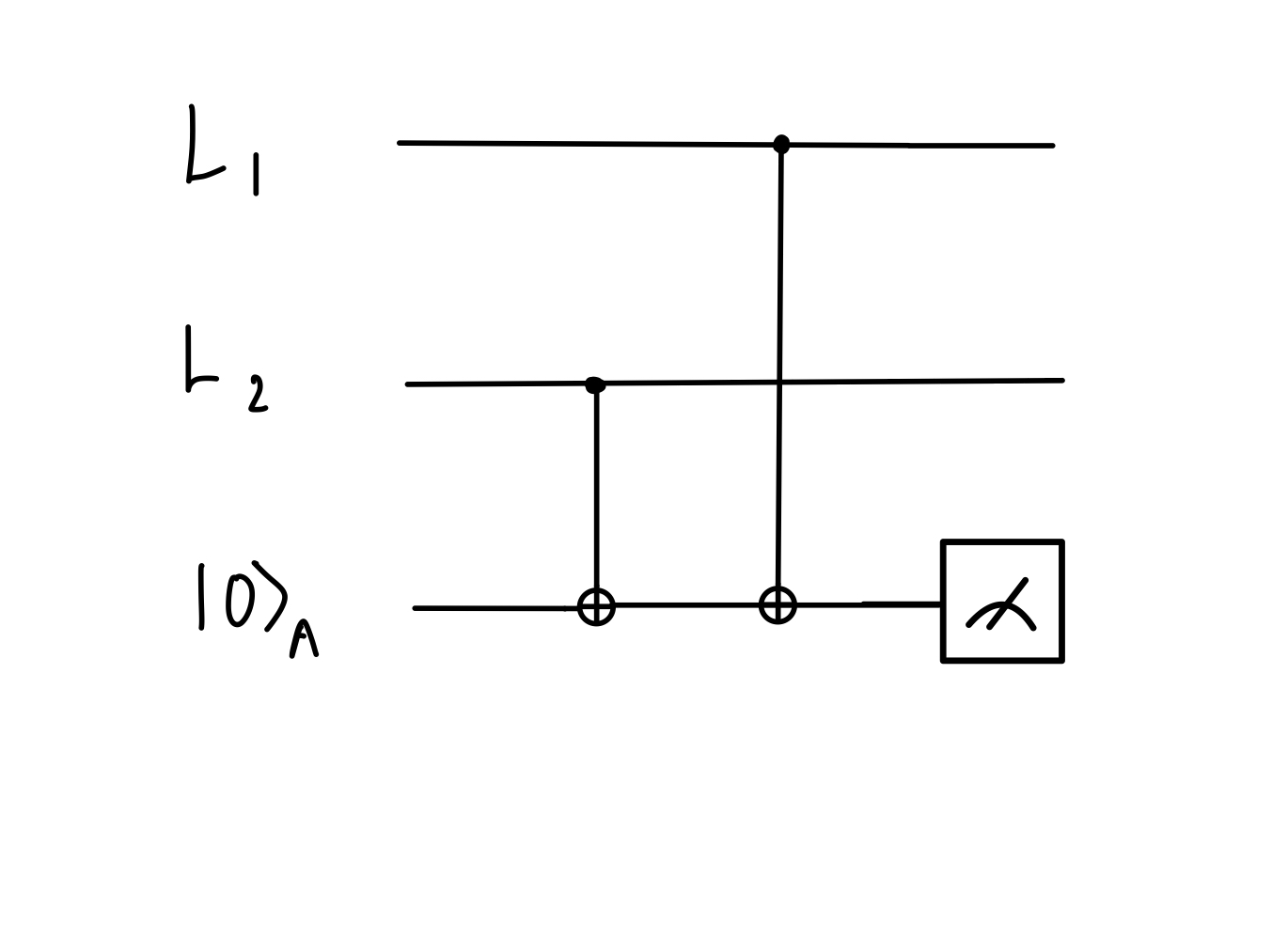
A simpler circuit can be used for measuring stabilizers that perform a parity check. The circuit for performing the parity check in the 2-bit repetition code is shown in the below figure.
A circuit that checks the parity of two qubits and stores the result in an ancilla. L1 and L2 are used to label the two physical qubits used to create the single logical qubit.
Firstly, the parity of two bits, i1,i2∈{0,1}, is given by i1⊕i2. This will be zero if both bits are zero or both bits are one. If the bits differ, it will be one.
Now, note that the action of a CNOT gate on some arbitrary computational basis state can be written as
This works because a CNOT gate applies an X gate to the second qubit if the first qubit is i1=1. This X gate will flip the second qubit, which can be done by adding 1 to it. Hence, if i1=0 nothing is added to the second qubit and it remains i2. If i1=1 then 1 is added to i2, flipping it.
From here, consider that if it is not known if an error has occurred on an arbitrary qubit encoded into the code space, Span{∣00⟩,∣11⟩}, the state can be written as